
A lived-in kitchen.
A personal voice.
Stirred Daily is the seventh publication: a rustic kitchen journal with warm wood, linen, aged metal and personal notes from cook Petey. This edition includes the connected cooking library and functioning kitchen tools.
Keep the identity together.
Current visual guidelines, version 2. The PDF and editable PowerPoint contain the same six-page visual foundation.
Download PDF · Download editable PowerPoint · Written interface and editorial rules
Web identity files
Logo master · SVG · Logo master · PNG · Share cover · JPG · Browser & home-screen icons · ZIP

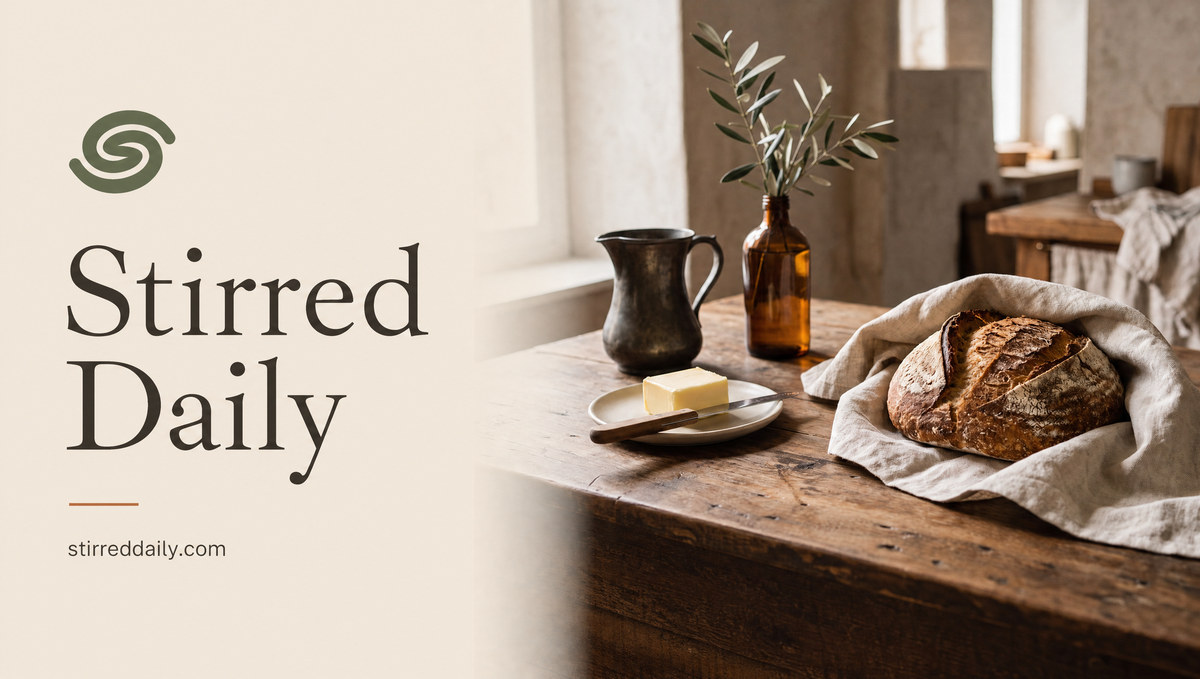
The share cover is flattened generated artwork. The logo masters and editable type sources remain separate; the icon set uses proportional exports of the existing mark.
Install the exact fonts before editing the PowerPoint: Ibarra Real Nova · Public Sans. Fonts are embedded in the PDF.
Domain: stirreddaily.com · registered at GoDaddy. The publication remains in staging while its launch details are completed.
01 / Make the kitchen feel familiar.
Audience: home cooks choosing equipment and learning useful everyday methods. The starting assumption is US English; locale is still provisional.
Promise: practical kitchen equipment and cooking guidance. The recommended balance is equipment and techniques supported by documented recipes, rather than a generic recipe archive.
Tagline: A well-used kitchen. A well-fed table.
A name that can hold the whole kitchen.
Stirred Daily connects a recognisable cooking action with an everyday rhythm. It can cover equipment, baking and food without tying the publication to a single appliance or dietary category. “Daily” is part of the name, not a promise to publish every day.
Alternatives considered: The Cooking Habit and Kitchen in Practice. The first is explicit but has nearby existing naming; the second communicates the method but is longer. Domain availability was checked through GoDaddy on 7 September 2026. Availability can change and is not trademark clearance.
Its own place in the network.
| Here | Elsewhere in the network |
|---|---|
| Cookware, knives, countertop cooking, recipes and baking | Home by Doing: repairs, renovation, installed fixtures and kitchen cabinetry |
| Food preparation and serving a meal | Ground & Gauge: coffee equipment, brewing and coffee drinks |
| Cooking with harvested ingredients | Garden in Reach: growing and caring for edible plants |
| Using kitchen linens and preparation tools | Made in Steps: sewing an apron or making a craft object |
02 / A quiet stirring gesture.
The stirring mark retains its original vector geometry. Its primary color is now Olive, applied through the canonical logo export. The website pairs it with an Ibarra Real Nova text name. The approved name is Stirred Daily.
Proposed usage: keep clear space of one quarter of the visible symbol height. Show the symbol at least 24 px high and the navigation name at least 28 px. Keep proportions intact and the symbol upright. Use the transparent Olive master on Linen or similarly light, quiet surfaces.
Do not stretch, redraw, distress, outline, rotate or add shadows to the mark. Never use CSS filters to create an unapproved color. Use the exact supplied export, with separate assets for any future approved variation.
Download the Olive master SVG · Download the transparent PNG
03 / The colors already in the kitchen.
#F1E9DC#342D25#62694D#A56F50#DFD2BCLinen is the page. Walnut carries the words. Olive gives the identity and actions a quiet anchor; Oat supports practical reference sections. Clay is a restrained decorative accent.
Use Walnut text on Linen and Oat. Use Linen text on Olive or Walnut. Clay is not a small-text color on Linen. Keep body text on a solid, readable surface; reserve the texture and patina for photographs. Selections always have labels and state attributes in addition to color.
| Token | Value | Use |
|---|---|---|
| --linen | #F1E9DC | Page background |
| --walnut | #342D25 | Reading text, fine rules, dark panels |
| --olive | #62694D | Identity, actions, selected controls |
| --clay | #A56F50 | Small decorative accents |
| --oat | #DFD2BC | Reference sections and notes |
04 / Read like a well-kept notebook.
Pull up a chair.
Public Sans. Clear quantities, useful controls and practical instructions.
Ibarra Real Nova Regular (400) sets the display and editorial headings. Its real italic font gives Petey’s notes a more intimate voice. Public Sans Regular (400) handles reading and controls; 600–700 is reserved for labels and meaningful emphasis. Keep the signature as text, not an invented handwritten autograph.
| Element | Desktop | Mobile |
|---|---|---|
| Hero heading | 72–88 px, 1.02 line height | 48–58 px |
| Section heading | 48–66 px, 1.07 line height | 38–46 px |
| Petey’s note | Real italic, 24–32 px | 24–28 px |
| Body | Public Sans, 16 px, 1.6 line height | 16 px, 1.6 line height |
| UI detail | Public Sans, 12–14 px | 12–14 px |
The kit self-hosts the exact font files with their OFL licenses. Ibarra Real Nova · Public Sans.
05 / Materials with a little history.
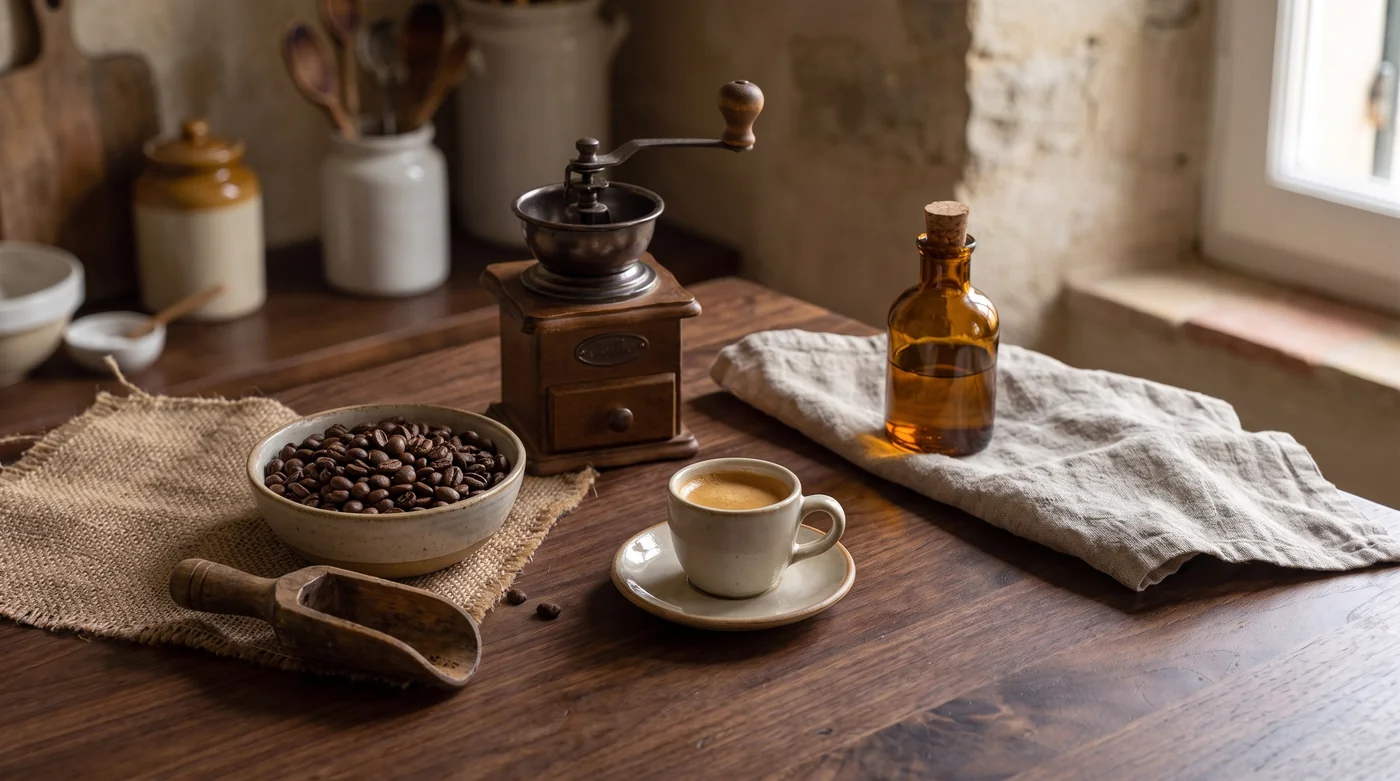
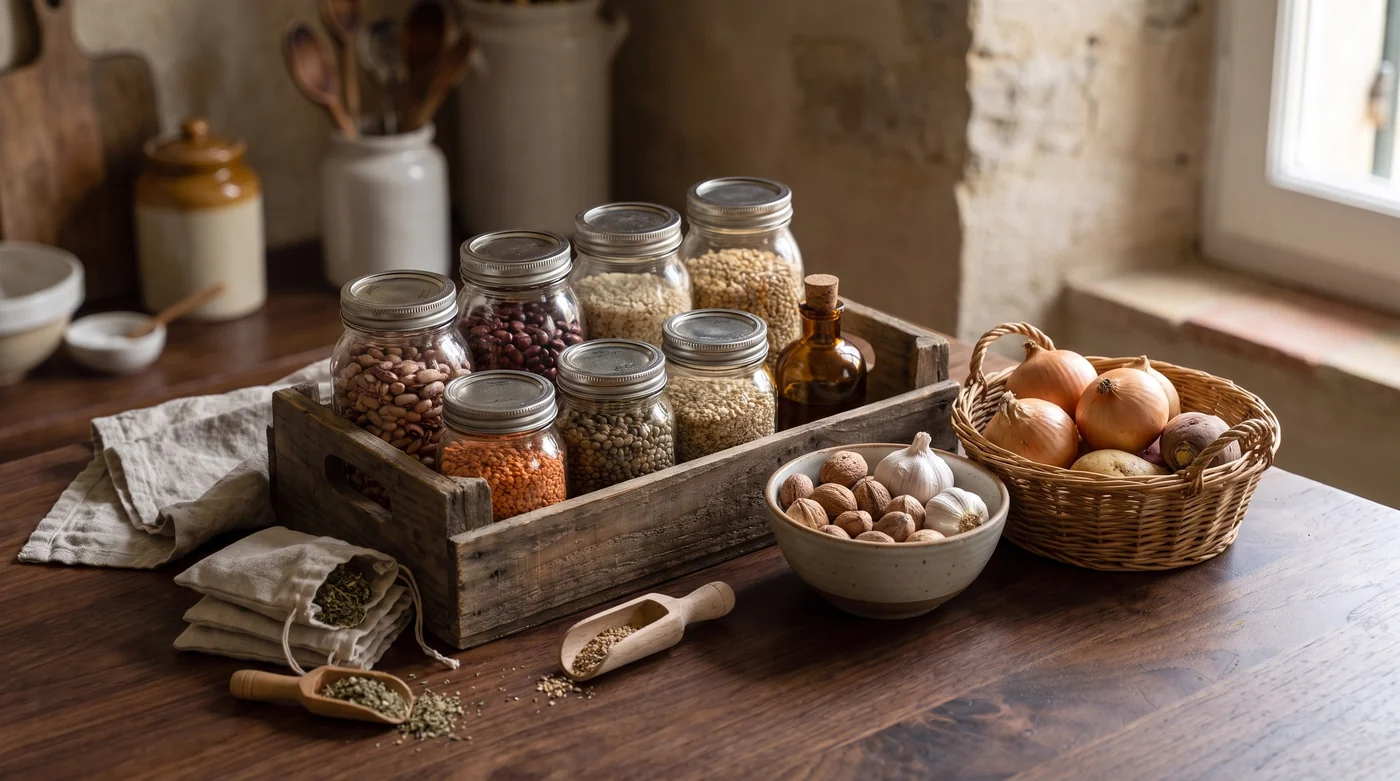
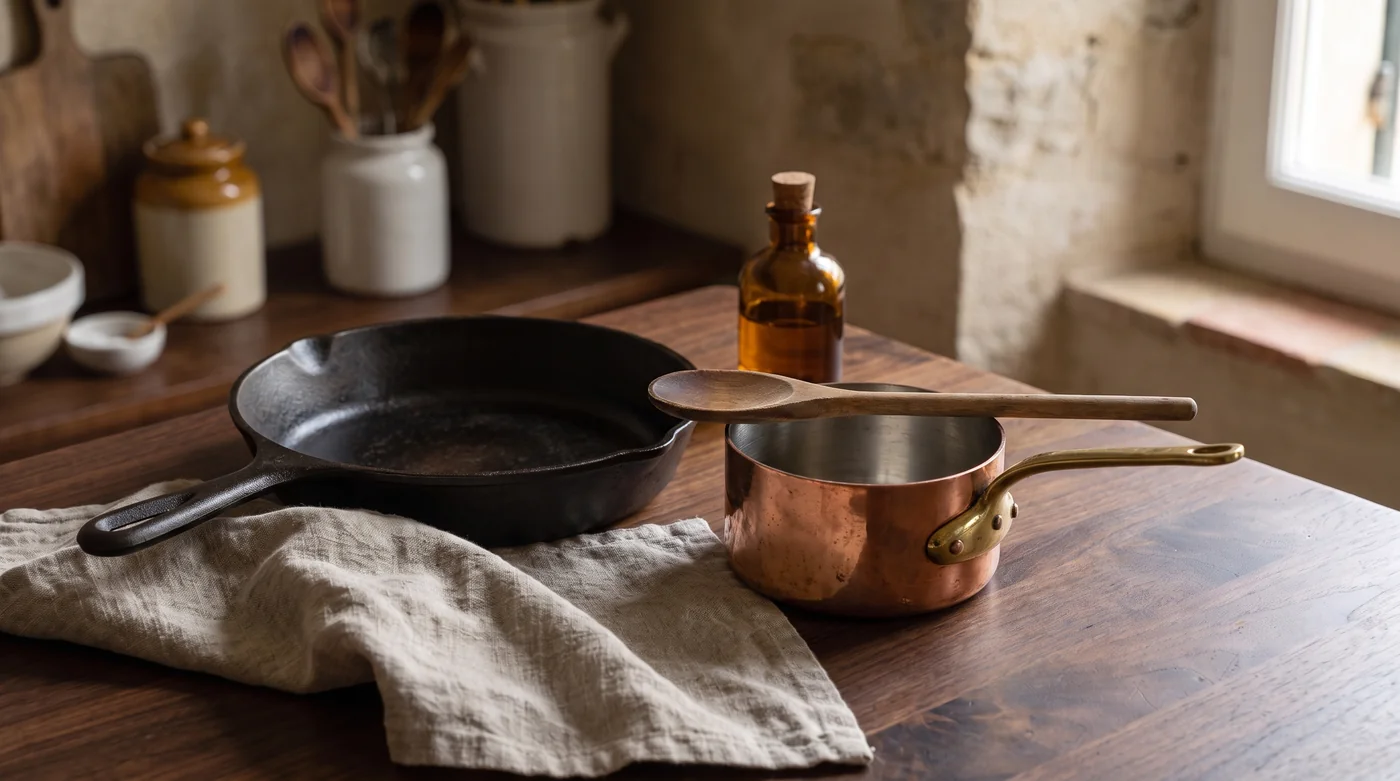
Worn, warm and useful.
Follow the supplied references through materials and light: dark walnut and oak, unbleached linen, old metal pitchers, seasoned cookware, amber glass and irregular ceramics. Let soft side light show the grain, weave and patina. Keep food colors natural and arrangements slightly informal.
Photograph a kitchen in use, with believable portions and practical objects. Vary a broad table view with closer food and tool details. Avoid bright checked-tablecloth styling, glossy product-ad lighting, plastic-looking surfaces, decorative clutter and artificial distressed UI textures.
The four rustic photographs are new Higgsfield illustrations informed by the user’s mood references. They do not depict Petey’s actual kitchen, possessions or cooking results. Do not reuse screenshots, product listings, interface chrome or third-party product names from the references on the public site.
Image delivery
Use 600 and 1400 px WebP variants, plus 2000 px for the wide hero. Preserve a useful crop on mobile. Give the hero priority, reserve image dimensions and lazy-load lower-page imagery. Keep provenance with each file.
06 / Useful controls, cookbook character.
A quiet editorial masthead leads into a generous rectangular table photograph. Open reading sections, uneven image emphasis and marginal cook’s notes create a kitchen journal rather than a generic card dashboard.
Spacing and shape
Use a 4 px spacing base, 20–28 px mobile gutters and up to 56 px desktop gutters. Cap content at 1392 px. Keep corners square or barely rounded, with fine Walnut rules. Avoid arch crops, bright sticker labels and pill-heavy controls. Patina lives in the photographs, not in fake distressed text.
Recipe component
Show weights and units together. Keep ingredients in reading order. Offer explicit quantity multipliers, keyboard-accessible checkboxes and an announced update when quantities change. Only ingredient amounts scale. Never multiply oven temperatures or cooking times. A production recipe also needs yield, preparation and cooking time, steps, author, evidence, tested substitutions and appropriate doneness guidance.
Technique component
The eight-method Technique Atlas uses labelled buttons and an announced result. Each method links to its own guide with setup, observable cues, relevant tools and limits. Filters expose their selected state, and method links remain available without JavaScript.
Motion and access
Use a small one-time entrance and a subtle image zoom. Honor reduced-motion preferences. Keep content visible without JavaScript. Every control needs a visible focus state; controls should be at least 44 px high. Mobile navigation opens explicitly and exposes its expanded state. Avoid carousels, scroll locking and essential information hidden on hover.
07 / Sound like someone who helps.
Voice: Petey is a Filipina woman living in Europe, as supplied by the user. Use personal, sensory observations in short notes; keep technical guidance clear and concrete. The copy in this kit is a draft written in that requested voice.
Petey’s notes
“I like a kitchen that feels lived in. A loaf on the board, a cloth on the table, and room for one more.”— Petey
Give a note one small thought: a preference, an invitation or something to notice. Use “I” naturally. Avoid a catchphrase on every card, exaggerated dialect and generic nostalgia. A few well-placed notes are enough.
Use Petey’s supplied identity naturally. Her country within Europe, migration history, family stories, credentials, possessions, portrait and test experience remain unprovided; do not invent them. Claims such as “I have used this pan for ten years” need real supplied evidence. Do not describe generated pictures as Petey’s kitchen or dishes. Keep draft voice copy separate from verified author metadata.
Choose equipment around the job.
Start with the cooking task, then define capacity, dimensions, compatibility, cleaning, storage, durability and replacement-part needs. Compare meaningful tradeoffs. Separate desk research from hands-on findings. Affiliate rates can affect business planning, but never determine a test conclusion or erase a useful non-affiliate option.
Show what backs a recommendation.
Keep model identifiers, dated manufacturer specifications, original measurements, photographs and the test method together. Do not invent scores, ownership, lab results, kitchen experience or recipe testing. Generated imagery and manufacturer specifications are not hands-on evidence.
Recipe and safety review
Recipes need reproducible ingredient weights, method notes and evidence before they are described as tested. Document changes between runs. Source storage, reheating, allergen and food-safety advice from relevant authoritative guidance and review it before publication. Avoid unsupported health, diet and “non-toxic” claims.
Disclosure and structured data
Place a clear affiliate disclosure where recommendations occur. Distinguish sponsored relationships. Use Recipe markup only on a real, complete, qualifying recipe page, and never invent ratings. Give articles real authors, sources and appropriate dates. The design sample is noindex and has no Recipe or Product rating markup.
Baking and alternatives
Confirmed by the user: Petey loves baking, including focaccia. Develop gluten-free and vegan alternatives as editorial subjects, including demanding bakes; do not claim Petey follows either diet. Treat the combined version as a separate recipe, with its own evidence. Never describe a recipe as tested from generated pictures or a draft formula.
08 / Build depth around seven subjects.
Cookware; prep tools; countertop cooking; cooking techniques; everyday recipes; baking and bakeware; food storage and preparation. Each gets a pillar with task-based navigation and supporting articles.
Signature destination: Cooking Technique Atlas. Develop clear method demonstrations, realistic imagery and comparisons, then connect equipment and recipe articles to the relevant method.
Companion tools are built: Baking Composition explains ingredient roles and scales weights; Starter Notebook calculates feeds and exports optional calendar check-ins; Pan Comparison compares base areas; Formula Comparison separates scaling from changed proportions; Sheet Pan Fit draws a measured rectangular space, a pan outline and an entered edge gap. None predicts a baking result or validates a substitution.
Infrastructure: retain a separate domain, Search Console property, GA4 property, contact mailbox, affiliate approvals, asset provenance and cost allocation. Share publishing contracts and technical components while retaining site-owned content and configuration for an independent sale.
Implemented tools: the starter notebook calculates feeding weights and hydration, stores journal entries optionally in this browser, and exports check-ins to an iCalendar file. The visitor imports that file into a calendar app to receive reminders. No email, push notification or background site reminder service is connected.
The baking notebook records the focaccia, gluten-free and vegan development direction.
Current publication routes
Seven pillars and 9 supporting articles · Eight-method Technique Atlas · Baking Composition, Starter Notebook, Pan Comparison, Formula Comparison and Sheet Pan Fit · Equipment shelf. Ingredient-role explanations are a learning aid, not a prediction of a finished recipe.
09 / Working kit, ready for review.
| Name | Stirred Daily is the selected publication name. |
|---|---|
| Domain | stirreddaily.com is registered at GoDaddy. DNS access has been verified. Trademark clearance is a separate matter. |
| Contact | Planned contact@stirreddaily.com. DNS has no mail service configured yet; legal operator and postal address remain to be supplied. |
| Research | A small US-English/German language-market screen was completed on 8 September using DataForSEO and SerpApi, including baking terms. It is not a full kitchen-niche assessment or proof of reachable traffic. The original niche rankings remain unchanged. |
| Analytics & search | Dedicated GA4 ID G-583B9LS878 is saved. Analytics remains disabled; this staging build is noindex. A Search Console verification TXT record is present in DNS. |
| Assets | Rustic brand imagery, an Olive logo, responsive WebP assets and per-image provenance are included. The focaccia scene is illustrative, not a recipe test. |
| Brandbook | Rustic revision 2: six-page PDF and matching editable PowerPoint. Full UI and Petey voice rules appear on this page. |
| Publication | Independent Cloudflare reference publication. Seven pillars, 9 supporting articles, eight technique pages, a Technique Atlas, five kitchen tools and support pages are built. Original recipe testing, legal details, active contact mail and approved affiliate destinations remain production work. |