
A WELL-USED KITCHEN. A WELL-FED TABLE.
Baking & bakeware

Baking, bakeware and ingredient quantities

A home for focaccia, starter care, baking tools and careful work on gluten-free and vegan alternatives.

Research & practical planningStirred Daily · research & practical guidance
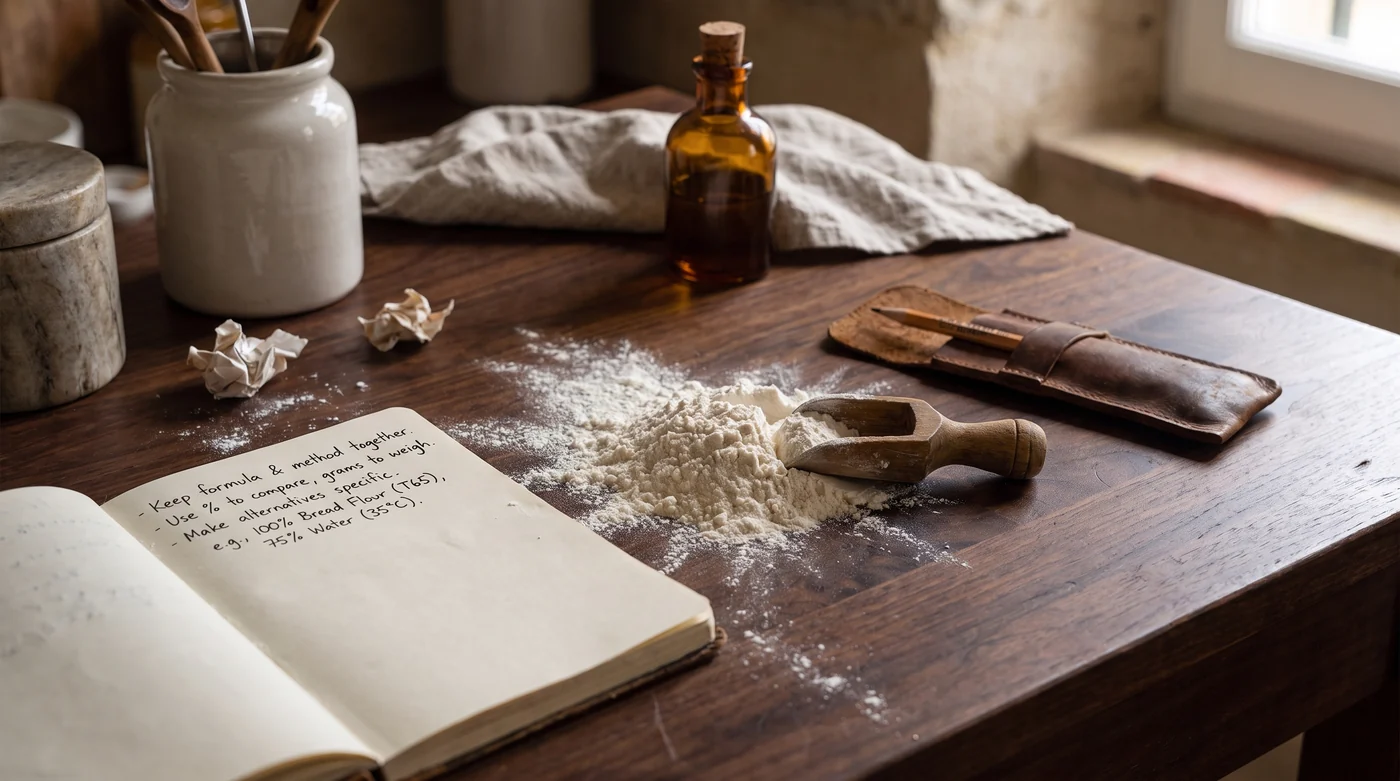
A recipe notebook beside a flour scoop on the kitchen table.
AI-generated editorial illustration

Keep the formula and the method together.

A list of percentages describes quantities, not a complete bake. The flour, mixing sequence, fermentation, pan and oven all belong in the same notebook. Start with a complete recipe from an identified source and record the version you actually make. Save the ingredient labels when a flour blend or substitute is part of the result.

Petey loves baking and focaccia, and that interest shapes this part of Stirred Daily. Our tools help organise the arithmetic and observations. They do not mean a displayed formula has been baked, tasted or approved by Petey.

Use percentages to compare, grams to weigh.

Baker’s percentages put total flour at 100 and express other ingredient weights against it. This makes two differently sized mixtures easier to compare. The Baking Composition tool shows the grams beside each percentage and a separate picture of each ingredient’s share of the total mixture.

Those two percentages have different denominators. The flour is always 100% in the baker’s table, but it will be less than 100% of the finished mixture’s weight. Added water is shown separately from milk and egg so the tool does not quietly count every liquid ingredient as pure water.

Make alternatives specific.

Gluten-free and vegan are different requirements. A recipe may address either, both or neither. Label the actual version, the exact flour blend and the replacements used. A successful egg-free wheat loaf does not demonstrate that removing gluten will work in the same formula.

For demanding bakes, begin with an independently developed recipe in the category you need. Use the role explorer to understand the question a substitution raises. Keep any claims of “tested” or “works with any flour” out of the notebook until there is evidence for the exact claim.

Make the pan part of the formula record.

Measure the interior at the base, note the depth and record the material. Our pan comparison calculates an area ratio for a comparable fill depth; it cannot tell you a universal new baking time. The shape, surface and recipe still need judgement.

Keep starter care in its own log. A feeding calculator can tell you the weights in a ratio. Your observations tell you how that starter behaved in your kitchen. The calendar exports planned check-ins, leaving the timing under your control.

A practical note

Take this to the kitchen.

Open the Baking Composition tool ↗

At the source

Original references consulted for this research edition. Manufacturer statements describe the named product; they are not our own test results.
Baking, bakeware and ingredient quantities: Keep the formula and the method together.; Use percentages to compare, grams to weigh.; Make alternatives specific.
READ THE DETAILS

Keep going with baking, bakeware and ingredient quantities

Questions to start with

How much batter goes into an 8 inch cake pan?

Depth matters. A straight-sided 8-inch round pan that is 2 inches deep holds about 1,647 ml to the rim. At an illustrative 66.7% fill, that is about 1,099 ml of batter. Measure your actual pan and follow the recipe’s fill allowance; the example is not a universal safe fill for every batter.

King Arthur Baking: why pan size matters ↗

Can I use 2 9 inch cake pans instead of 3 8 inch pans?

At equal batter depth, compare the combined base areas: two 9-inch rounds have about 84.4% of the area of three 8-inch rounds. Scaling every weighed ingredient by about 0.844 preserves that geometric depth assumption. Putting the full batch into the smaller combined area makes a deeper layer. Check capacity and the recipe before changing pans.

King Arthur Baking: alternative pan sizes ↗

Can I use a 9x5 loaf pan instead of 8x4?

At the same depth, a 9 × 5 rectangle has about 40.6% more base area than an 8 × 4 rectangle. Actual loaf pans often taper and vary in depth, so measure water capacity for a better comparison. An unchanged recipe may produce a shallower loaf in the larger pan; arithmetic alone does not determine the new bake time.

King Arthur Baking: choosing baking pans ↗

What is the best feeding ratio for sourdough starter?

The appropriate ratio depends on the maintenance routine, temperature and when the starter is needed. Ratios describe starter, flour and water by weight. A 1:2:2 feed with 20 g starter uses 40 g flour and 40 g water, for 100 g total. Use the Starter Notebook to calculate and record feeds; observe the starter instead of treating a clock reminder as proof of readiness.

King Arthur Baking: sourdough guide ↗

What size pan can I substitute?

Compare the usable capacity and the batter depth your recipe expects. Our Pan Workshop accepts inside dimensions or measured water capacity, then applies your chosen fill allowance. If you already know the batter volume, use Find a Pan. The candidates are idealized size examples, so check the actual vessel and oven fit before baking.

King Arthur Baking: recipe scaling ↗

How many cups of batter are in a cake pan?

Capacity depends on the inside shape and depth. One US customary cup is about 236.6 ml; a metric cup is commonly 250 ml, so name the unit. Our tool reports millilitres and uses US cups only when that unit is selected. Brimful capacity and the planned amount of batter are shown separately.

NIST: volume units ↗

All guides · All questions

Stirred Daily

Your privacy choices

Google Analytics is currently off. Our calculators work without analytics. Notes you choose to save stay in this browser.

Our privacy notice describes local storage, hosting and external links.

Privacy and storage details