
The journal
How to check if your digital kitchen scale is accurate
Check a scale with a suitable known reference, repeated readings and its model-specific specification. Distinguish resolution, repeatability, accuracy and adjustment.

Check a kitchen scale with a suitable reference mass, repeated readings and the instructions for its exact model. Returning to zero is useful, but does not prove accuracy. A display that changes in 1-gram steps also does not guarantee that every reading is within 1 gram of the true mass.
Set up a fair check
Put the scale on a firm, level surface, with its feet supported and the platform clear of nearby objects. Check the batteries and selected units. Let the reading settle as the manual directs. Keep the bowl entirely on the platform: if it touches a wall or counter, part of its load is supported elsewhere.
Use a reference weight intended for checking scales, with a known mass and suitable stated tolerance. A food package’s nominal net quantity or a handful of used coins is not an accurate calibration standard. Without a suitable reference, you can assess repeatability, but you cannot establish the scale’s actual error confidently.
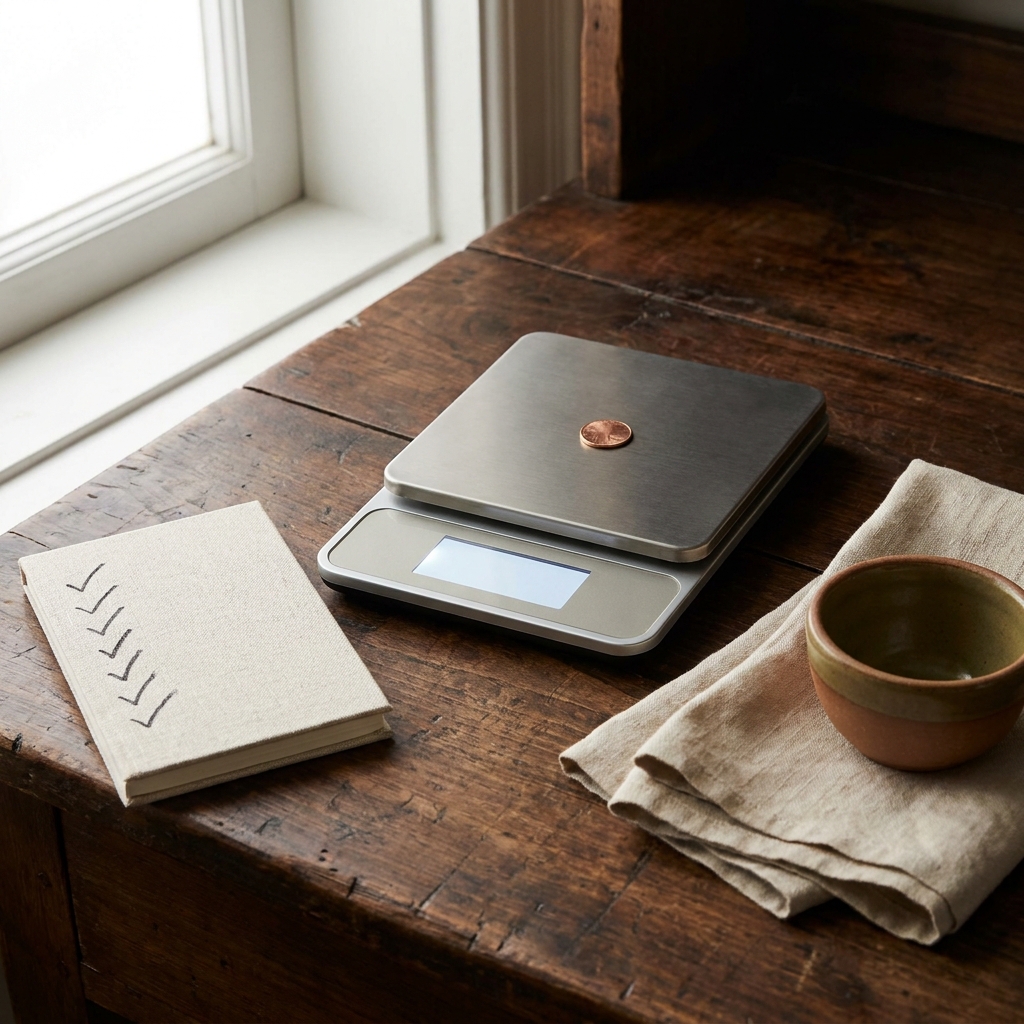
Record what the scale does
- Zero the empty platform. Place the reference near its centre without exceeding the capacity.
- Record the mass shown and compare it with the reference’s stated mass.
- Remove the load, check zero and repeat. Do not change several conditions between trials.
- If the maker recommends checking more than one load, use appropriate reference masses across the range you actually use.
- Compare the differences with the exact model’s specification and the requirement of your task. Keep the reference uncertainty and display resolution in mind.
A clearly hypothetical example: a 100.0 g reference repeatedly displays 102 g. The observed difference is about +2 g at that load. That does not prove the same offset applies at 5 g or 2 kg, and subtracting 2 g from every ingredient is not a substitute for repair or proper adjustment.
Checking is different from adjusting
Do not enter an undocumented button sequence or use an approximate weight to recalibrate. The Escali L-series manual illustrates why the exact model matters: different models require different calibration masses. Its procedure is not a universal instruction for other kitchen scales.
If the manual provides no user adjustment, contact the maker with the model, units, reference mass and repeated readings. Replace or service a scale that cannot meet its stated performance rather than inventing a tolerance for all kitchen use.

Match the scale to the ingredient
The same absolute difference matters much more in a small dose. A hypothetical 1 g difference is 20% of 5 g but 0.2% of 500 g. Choose a scale whose usable range and verified performance suit the quantity; do not assume that adding ingredients slowly overcomes its minimum-load or rounding limits.
Put this into practice
Record the reference mass, displayed result and repeated return to zero together. Use the exact model’s specification to judge the difference; repeatability alone does not establish accuracy or justify subtracting one offset from every recipe.
Before you start
Related kitchen skills